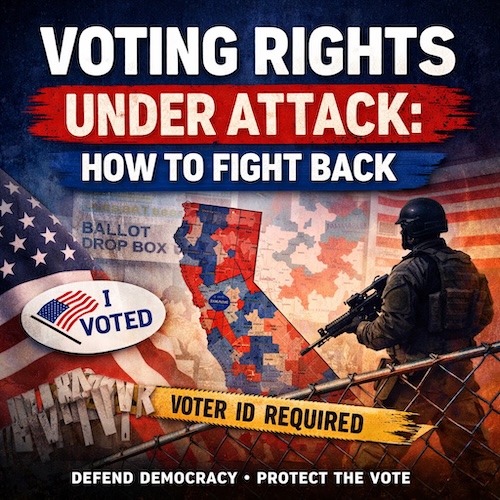
Voting Rights Under Attack: How to Fight Back
California is widely known for having some of the strongest voter protections in the United States. The state allows automatic voter registration, same-day registration, universal vote-by-mail, and early voting.
However, strong laws alone do not guarantee secure voter rights. Voting rights can weaken through legal challenges, administrative decisions, misinformation campaigns, and local policy changes.
Across California, several real challenges have emerged that affect voter participation and election integrity.
This article examines the most significant threats to voter rights and provides practical solutions that citizens can use to defend democracy.
1. Attempts to Restrict Voting Access
The Challenge
One major threat to voter rights involves proposals that make voting more difficult.
In recent years, voter identification proposals have gained attention in California. Some advocates have attempted to place a statewide voter ID requirement on the ballot. Local governments have also attempted to adopt their own voter ID rules.
Real Example
The city of Huntington Beach approved a measure requiring voter identification for municipal elections. The policy also allowed monitoring of ballot drop boxes.
State officials challenged the measure. California courts ruled that the policy violated state election law and blocked the city from implementing the rule.
The case demonstrated that local jurisdictions may attempt to impose voting restrictions even when state law protects voter access.
Why This Matters
Voting barriers do not affect all voters equally. Restrictions often impact:
• elderly voters
• low-income residents
• people with disabilities
• students
• naturalized citizens
• communities of color
Many voters may not possess the specific identification required by strict laws. Others face transportation barriers when obtaining identification.
Even small administrative barriers can reduce turnout.
Solutions and How to Fight Back
Support Strong State Laws
Statewide voting protections prevent local governments from creating restrictive voting systems.
Citizens can advocate for legislation that:
• protects universal vote-by-mail
• prevents local voter ID requirements
• expands early voting locations
• increases language access for voters
Contacting state legislators and attending public hearings helps ensure strong voter protections remain in place.
Participate in Ballot Initiative Campaigns
California citizens have the power to influence election laws through ballot initiatives.
If a restrictive measure qualifies for the ballot, voters can:
• educate neighbors about the issue
• volunteer for advocacy campaigns
• participate in public forums
• distribute fact-based voter guides
Public education campaigns often determine whether restrictive measures succeed or fail.
Volunteer as a Poll Worker
Poll workers ensure elections run smoothly.
California regularly faces shortages of trained poll workers.
Serving as a poll worker allows citizens to:
• assist voters who face difficulties
• ensure voting procedures follow state law
• protect voters from intimidation
• help resolve administrative problems
Election workers are a critical defense against voter suppression.
2. Voter Intimidation and Ballot Interference
The Challenge
Another threat involves intimidation or interference with voters.
This may include:
• harassment at polling locations
• aggressive monitoring of ballot drop boxes
• spreading false information about voting rules
• interfering with mailed ballots
Even isolated incidents can discourage voters from participating.
Real Example
In Sacramento, law enforcement discovered dozens of stolen election ballots inside a homeless encampment. Election officials canceled the ballots and issued replacements to affected voters.
The situation did not alter the election outcome. However, it demonstrated that interference with ballots can occur.
Election officials emphasized that security systems allowed them to detect the problem.
Solutions and How to Fight Back
Track Your Ballot
California provides ballot tracking systems that allow voters to confirm:
• when their ballot was mailed
• when it was received
• when it was counted
Every voter should track their ballot status.
Ballot tracking quickly reveals whether a ballot has been delayed or lost.
Report Intimidation Immediately
Federal law protects voters from intimidation.
Citizens should report incidents to:
• local election officials
• election protection hotlines
• civil rights organizations
Documenting incidents helps authorities investigate and prevent future problems.
Join Election Protection Programs
Nonpartisan election protection groups train volunteers to assist voters on election day.
Volunteers help by:
• answering voter questions
• assisting voters who face problems
• observing polling locations
• documenting irregularities
Election protection programs provide an important safeguard for voters.
3. Gerrymandering and District Manipulation
The Challenge
Election districts determine which communities have political representation.
When district lines are manipulated for political advantage, voters lose equal influence.
California uses an independent redistricting commission. However, disputes over district maps still occur.
Real Example
In past decades, federal courts ruled that district maps in Los Angeles County diluted Latino voting power. Courts ordered new district boundaries that allowed fair representation.
More recently, legal challenges have questioned whether some congressional districts comply with federal voting rights protections.
Solutions and How to Fight Back
Participate in Redistricting Public Hearings
Redistricting commissions hold public meetings where citizens can provide testimony.
Citizens can:
• submit proposed district maps
• describe community boundaries
• present evidence of unfair district lines
Public participation influences final district decisions.
Support Independent Redistricting Commissions
Independent commissions reduce political manipulation of district lines.
Citizens can advocate policies that:
• limit political interference
• require transparent mapping processes
• publish draft maps for public review
• ensure diverse commission membership
Transparent mapping strengthens public trust.
Use Legal Challenges When Necessary
Courts remain a powerful defense against unfair district maps.
Civil rights groups often file lawsuits when maps violate voting rights protections.
Community members can support these efforts by:
• providing testimony
• submitting demographic data
• documenting representation concerns
Legal action has historically corrected discriminatory district boundaries.
4. Attempts to Obtain or Misuse Voter Data
The Challenge
Voter databases contain sensitive personal information.
Unauthorized access to voter data can threaten privacy and discourage voter participation.
Government agencies and political groups sometimes attempt to obtain voter databases for investigative or political purposes.
Real Example
A federal lawsuit sought access to California’s statewide voter registration database. The request included personal information such as driver license numbers and partial Social Security numbers.
A federal judge rejected the request and warned that releasing such data could threaten voter participation.
Solutions and How to Fight Back
Strengthen Privacy Laws
Strong privacy protections prevent misuse of voter information.
Citizens can advocate legislation that:
• limits access to sensitive voter data
• strengthens cybersecurity protections
• imposes penalties for unauthorized use of voter information
Protecting voter privacy encourages participation.
Support Election Security Investments
Election infrastructure requires constant modernization.
Advocacy efforts can support funding for:
• secure voter registration systems
• cybersecurity protection for election databases
• secure ballot tracking technology
• post-election auditing procedures
Modern security systems protect both voter privacy and election integrity.
Encourage Transparency
Transparency builds public trust.
Election offices should publicly explain:
• how voter data is protected
• how election systems operate
• how ballots are counted and verified
Citizens should request public briefings from local election officials.
Open information reduces misinformation.
5. Disinformation About Elections
The Challenge
Disinformation campaigns often attempt to convince voters that elections are fraudulent or unreliable.
False narratives can spread quickly through social media.
Common misinformation topics include:
• claims of widespread voter fraud
• confusion about voter registration rules
• false claims about ballot counting procedures
These narratives can discourage participation.
Solutions and How to Fight Back
Promote Accurate Civic Education
Education is one of the most effective tools against misinformation.
Communities can organize programs that explain:
• how elections are conducted
• how ballots are verified
• how vote counting works
• how election audits confirm results
Public understanding reduces vulnerability to false claims.
Share Verified Information
Citizens should rely on credible sources such as:
• state election offices
• county registrars of voters
• reputable nonpartisan organizations
Before sharing election information online, verify its accuracy.
Responsible communication protects public trust.
Support Independent Journalism
Investigative journalism often exposes misinformation and election interference.
Citizens can support credible reporting by:
• subscribing to reputable news outlets
• sharing verified reporting
• supporting nonprofit investigative journalism
Reliable journalism strengthens democratic accountability.
The Most Powerful Defense of Voting Rights
The strongest protection for democracy is active citizenship.
Voting rights remain secure when citizens:
• vote in every election
• monitor election processes
• volunteer in their communities
• educate neighbors about voting rights
• hold public officials accountable
History shows that democratic rights survive when citizens defend them.
Voting rights are not self-executing. They require vigilance, participation, and civic courage.
The responsibility to protect democracy ultimately belongs to the people.
Disclosure and Disclaimer: This article was prepared by San Jose CAN with the assistance of artificial intelligence for research and editorial support. While the information presented is believed to be accurate, it is provided for general informational purposes only. Readers are responsible for conducting their own independent research and verification before relying on or acting on any information in this article.