2026 California General Election (Midterm)
The California General Election in 2026 is one of the most important civic events in the state. This election determines who will lead California at the state and federal levels for the next several years. It also allows voters to decide major policy questions through statewide ballot measures.
This election is often referred to as a midterm election because it occurs halfway through the four-year U.S. presidential term. During midterm elections, voters choose many national, state, and local officials who shape laws, budgets, and public policy.
Key Dates for the 2026 California General Election
Election Day:
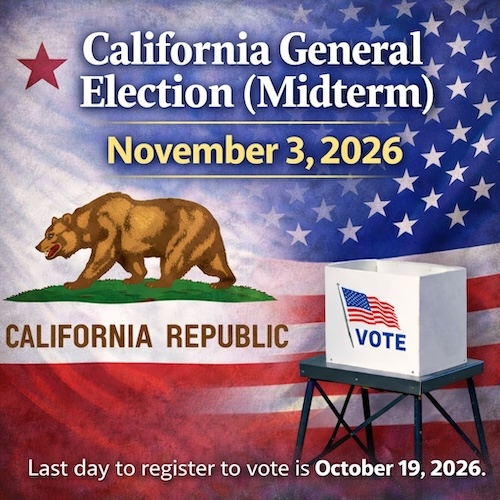
Tuesday, November 3, 2026
California uses a universal vote-by-mail system, meaning every active registered voter automatically receives a ballot in the mail before the election.
Important Voting Dates
Ballots mailed to voters
• Beginning approximately October 5, 2026 (about 29 days before Election Day)
Vote-by-mail period
• Early October 2026 through November 3, 2026
Vote centers open for early in-person voting
• Typically 10 days before Election Day in most counties
Last day to register to vote (standard deadline)
• October 19, 2026 (15 days before the election)
Conditional same-day registration
• Available October 20 through November 3, 2026 at county election offices or vote centers
Election Day – last day to vote
• November 3, 2026, by 8:00 PM
Mail ballots deadline
• Must be postmarked on or before November 3 and usually must arrive within 7 days after Election Day.
What the California General Election Is
The General Election is the final election that determines who wins public office.
Earlier in the year, California holds a Primary Election (June 2, 2026). In that election, candidates compete to advance to the general ballot under the state’s “Top-Two Primary” system, where the two candidates receiving the most votes move on to the November election regardless of party affiliation.
In the November General Election, voters choose the final winners for each office.
What Appears on the 2026 California Ballot
The exact ballot varies by county and district, but most voters in California will see five main categories of choices.
1. Statewide Constitutional Offices
In 2026, California voters will elect several top statewide leaders. The most prominent race is the Governor of California, since the current governor is term-limited and cannot run again.
Common statewide offices on the ballot include:
• Governor
• Lieutenant Governor
• Secretary of State
• State Treasurer
• State Controller
• Attorney General
• Insurance Commissioner
• Superintendent of Public Instruction
These officials oversee major functions of state government such as elections, law enforcement, public education, and financial oversight.
2. United States Senate
California voters will elect a United States Senator if a Senate seat is scheduled for election in that cycle.
U.S. Senators serve six-year terms and represent the entire state in Congress. They vote on federal laws, national budgets, and judicial confirmations.
3. United States House of Representatives
All 52 California congressional districts elect a representative to the U.S. House every two years. (Wikipedia)
Members of the House:
• Serve two-year terms
• Represent a specific congressional district
• Vote on federal laws, taxes, and national policies
These elections help determine which political party controls the U.S. House of Representatives.
4. California State Legislature
Voters also choose members of the California Legislature, which writes and passes state laws.
California State Senate
• About 20 Senate seats appear on the ballot in 2026
• Senators serve four-year terms
California State Assembly
• All 80 Assembly seats are elected every two years
State legislators decide laws affecting education, housing, taxation, transportation, and environmental policy.
5. State Ballot Propositions
California voters can directly vote on state laws and constitutional amendments through ballot propositions.
These measures may include:
• Constitutional amendments
• Changes to tax policy
• Criminal justice reforms
• Environmental regulations
• Election law changes
• Government spending programs
Ballot propositions may come from:
• Citizen initiatives
• The state legislature
• Referendums challenging existing laws
Each proposition appears with a Yes or No vote, allowing voters to directly shape state policy.
6. Local Elections
In addition to statewide and federal races, ballots usually include local government elections, which vary by county or city.
Examples include:
• County supervisors
• City council members
• Mayors
• School board members
• Community college trustees
• Local judges
• Special district boards
Local elections often have a direct impact on everyday issues such as housing, policing, schools, and infrastructure.
The Purpose of the California General Election
The California General Election serves several critical democratic functions.
1. Choosing Government Leadership
Voters select the leaders who will manage government institutions and implement laws.
2. Determining Legislative Power
Election results determine the balance of power in Congress and the California Legislature.
3. Deciding Public Policy
Ballot measures allow voters to pass laws directly without relying solely on elected officials.
4. Ensuring Accountability
Regular elections allow citizens to evaluate the performance of current leaders and either reelect them or replace them.
Why the 2026 Election Matters
The 2026 election will shape California’s political direction for the remainder of the decade. Major leadership positions, including the governor and many legislative seats, will be decided. Congressional races will also influence national politics because control of the U.S. House often shifts during midterm elections.
The policies enacted by the leaders chosen in this election will affect areas such as:
• Economic development
• Housing affordability
• Environmental protection
• Education funding
• Public safety
• Health care policy
Final Thought
The California General Election in 2026 is an opportunity for voters to shape the future of their state and nation. Every registered voter has the power to influence leadership, laws, and public priorities. Participating in the election ensures that government reflects the will of the people and that democracy remains strong.
Disclosure and Disclaimer: This article was prepared by San Jose CAN with the assistance of artificial intelligence for research and editorial support. While the information presented is believed to be accurate, it is provided for general informational purposes only. Readers are responsible for conducting their own independent research and verification before relying on or acting on any information in this article.